Temecula Slab Leak Specialist — Fast, Licensed & Available 24/7
Professional Temecula Valley leak detection to help protect your property, reduce hidden water loss, and identify the right repair path across the Inland Empire.
When you search for slab leak detection Temecula CA, you need a qualified plumbing team that can investigate the real source of the problem—not guess from one symptom alone. Resort Temec Plumbers provides professional slab leak detection, hidden water-leak diagnosis, underground water-line evaluation, and repair planning for homes, HOAs, rental properties, and commercial buildings throughout Temecula and eligible Inland Empire service areas.
- Professional Diagnosis for Suspected Slab Leaks
- Acoustic Listening & Thermal Assessment
- Pressure Testing & Plumbing Isolation
- Repair, Rerouting & Repiping Guidance
- 24/7 Emergency Response Across Temecula
- C-36 Licensed & Fully Insured
Call (951) 793-0002 for urgent slab leak inspection, hidden water-leak diagnosis, and clear repair options.
Request Slab Leak Service
Fill out the form below and our team will contact you immediately!
Free Electronic Leak Detection AvailableSlab Leak Detection Backed by 30+ Years of Experience
Partner with a local plumbing team that approaches hidden-water-loss concerns with careful testing, clear communication, and practical repair options.
A suspected slab leak can feel overwhelming because the source may be hidden beneath flooring, concrete, walls, cabinets, or landscaping. Resort Temec Plumbers starts with the visible signs, your water-use history, and the condition of accessible plumbing components. We then use an organized diagnostic process to help determine whether the concern is related to an under-slab line, a wall leak, an irrigation issue, a fixture connection, a water-main concern, a drain line, or another plumbing problem.
Homeowners and property managers want an honest answer before approving invasive work. Our goal is to identify the likely leak location, explain what the diagnostic findings mean, and discuss repair options in straightforward language.
Slab Leak Detection Near Temecula Landmarks & Neighborhoods
Serving properties around Old Town Temecula, Pechanga Resort & Casino, Temecula Valley Wine Country, and key community corridors.
Whether your property is in South Temecula, near Old Town, close to Pechanga, along Rancho California Road, within a Temecula Valley neighborhood, or near a commercial corridor, concealed water leaks deserve prompt, careful attention. Water beneath flooring or inside building materials can spread away from the actual source, which is why a wet spot or warm floor may not reveal the precise location of the problem.
Temecula Neighborhoods
- Old Town Temecula
- South Temecula
- Redhawk
- Harveston
- Wolf Creek
- Paloma del Sol
- Paseo del Sol
- Rancho Highlands
- Crowne Hill
- Vail Ranch
- Temecula Wine Country
- Pechanga-area properties
Nearby Cities
Regional Landmarks
- Old Town Temecula
- Pechanga Resort & Casino
- Temecula Valley Wine Country
- Wilson Creek Winery
- Ponte Winery
- Callaway Vineyard & Winery
- Europa Village Wineries & Resort
- Rancho California Wine Trail
- De Portola Wine Trail
- Vail Headquarters
- Temecula Valley Museum
- Pennypickle's Workshop
Specialized Detection for Water Lines, Underground Plumbing & Hidden Leaks
Inland Empire leak-detection specialists focused on evidence-based diagnosis before repair decisions are made.
A slab leak involves more than finding a wet floor. Water can travel through soil, concrete, wall cavities, cabinets, flooring materials, and framing before becoming visible. A proper evaluation may require checking water-meter movement, pressure behavior, visible moisture, hot-water patterns, accessible supply lines, fixture connections, irrigation systems, drain components, and other possible sources.
Resort Temec Plumbers provides plumbing leak detection for suspected under-slab water-line leaks and related hidden plumbing concerns. We use the facts available at the property to narrow down the likely source, then explain the next diagnostic or repair step. A confirmed or suspected slab leak should be evaluated by qualified plumbing professionals because repair decisions can affect water service, flooring, walls, concrete, pipe routing, and the overall plumbing system.
Professional Evaluation
Water lines, accessible plumbing, meter behavior, and hidden leak symptoms assessed with care.
Method Selection
Diagnostic methods chosen based on property layout, plumbing materials, and accessibility.
Repair Experience
Direct-access repair, water-line rerouting, repiping, and related leak-repair planning.
Clear Communication
Explanation of findings, limitations of testing, and practical next steps.
What Happens When a Slab Leak Develops in Temecula?
Common signs Temecula property owners notice and why professional diagnosis matters.
A slab leak may occur when a water line beneath, within, or near a concrete slab develops a leak. Because the pipe is concealed, the first sign may not be water coming through the floor. Property owners often notice a high water bill with no visible leak, water running when nothing is on, a moving water meter, warm tile in one location, damp carpet, reduced water pressure, recurring moisture, mildew odors, or water stains near the base of a wall.
These symptoms can also have other causes, such as a leaking fixture, failed supply line, irrigation leak, water-main issue, roof or wall intrusion, appliance connection, drain problem, or plumbing leak inside a wall. Resort Temec Plumbers investigates the source before recommending a repair path.
A slab leak can contribute to moisture-related damage and, in some situations, may affect soil conditions around a structure. However, the effect on a particular property depends on the location, duration, water volume, soil, foundation design, drainage, pipe condition, and other site-specific factors. A qualified inspection is necessary before drawing conclusions about structural impacts.
Prevent Hidden Water-Loss Problems with Routine Inspections
What Temecula homes, HOAs, and commercial properties can do to spot water-line concerns earlier.
Standard residential properties do not typically need annual "slab leak certification." However, routine plumbing inspections and water-use monitoring can help property owners identify abnormal water consumption, deteriorating supply connections, pressure changes, recurring moisture, aging water lines, and other warning signs before a concealed leak becomes more disruptive.
For commercial buildings, HOAs, multi-unit properties, wineries, restaurants, hospitality facilities, and high-use sites, scheduled plumbing assessments can support preventive maintenance.
| Maintenance Task | Description | Typical Timing | Benefit |
|---|---|---|---|
| Water-use review | Compare current bills and water use with normal patterns | Monthly or when bills change | Helps identify unexplained increases early |
| Water-meter observation | Check for unusual meter movement when water use is paused | As needed when a leak is suspected | Can indicate ongoing water use that needs diagnosis |
| Accessible plumbing inspection | Inspect exposed pipes, valves, fixtures, water heaters, supply lines | Annually or as needed | Helps rule out visible leaks before invasive work |
| Pressure and system checks | Assess plumbing behavior when leak symptoms are present | During a service visit | Supports diagnosis of possible water-line concerns |
| Moisture and flooring review | Check warm areas, damp spots, staining, odors, recurring moisture | When symptoms appear | Helps document concerns and prioritize investigation |
| Repair planning | Recommend repair, rerouting, repiping based on findings | After confirmed diagnosis | Supports informed, property-specific decisions |
Seasonal Planning Guidance
- Review water bills during periods of stable occupancy to spot unexpected increases.
- Inspect plumbing after a prolonged absence, tenant turnover, remodel, irrigation change, or major water-use shift.
- Address water-running sounds, warm flooring, moisture, low pressure, or musty odors promptly.
- Coordinate leak detection with water heater, water-line, fixture, irrigation, drain, or repiping evaluations when symptoms overlap.
Cost range note: Slab leak detection and repair costs vary based on the property layout, plumbing system, leak accessibility, diagnostic time, water-line material, location of the leak, needed repair method, restoration needs, and whether service is scheduled or emergency. Resort Temec Plumbers provides clear findings and repair-path options before major work is approved.
Who Needs Slab Leak Detection in Temecula?
From single-family homes to commercial campuses, HOAs, restaurants, and hospitality properties across the Inland Empire.
A concealed water leak can affect nearly any property with water lines beneath or near concrete, finished floors, walls, foundations, landscaping, or other concealed areas. Homeowners may notice a warm section of tile or a rising water bill. A property manager may see moisture recurring in several units. A business owner may discover low pressure, a wet floor, or water loss affecting daily operations.
Homeowners
Concerned about high water bills, warm floors, wet carpet, moisture, running-water sounds, or low pressure.
Landlords & Rental Managers
Responding to unexplained water use, recurring leaks, and moisture complaints across units.
HOAs & Apartments
Managing shared water systems, multi-unit plumbing, and property-wide maintenance concerns.
Restaurants & Wineries
Cafés, tasting rooms, and food-service businesses with active water leaks or hidden plumbing concerns.
Hotels & Hospitality
Venues, offices, and retail properties with water-loss issues affecting daily operations.
Medical & Community
Clinics, schools, churches, and community facilities needing prompt plumbing investigation.
Warehouses & Industrial
Workshops, utility buildings, and commercial sites with underground water-line concerns.
Facility Managers
Seeking coordinated diagnostics, repair planning, and documented plumbing recommendations.
How Temecula Weather, Water Use & Pipe Conditions Affect Hidden Leaks
Warm, dry seasons, water-system variables, aging materials, and property-specific conditions all influence plumbing performance.
Temecula's Mediterranean climate includes warm, dry summers and cooler, wetter winters. Seasonal temperature changes, property occupancy, landscape irrigation, water demand, pipe material and age, installation methods, water pressure, prior repairs, and water chemistry can all influence plumbing-system wear. Temecula's weather context can help explain why property owners monitor water use and moisture differently throughout the year, but climate alone does not diagnose a slab leak.
Water chemistry and mineral content can also vary by provider and source. Mineral deposits may affect certain plumbing components over time, but no plumber should claim that hard water is the universal cause of every Temecula slab leak. A professional inspection is necessary to evaluate the actual water-line condition and the symptoms at your specific property.
Summer
Increased irrigation, pool use, guest activity, cooling demand, and outdoor water use can make it important to distinguish a slab leak from an irrigation, hose-bib, or exterior water-line issue.
Winter
Rain and surface moisture can complicate visual leak assessment, making it important to separate plumbing leaks from drainage, roof, wall, or exterior water-intrusion concerns.
Spring & Fall
Seasonal startup of irrigation systems, property turnovers, remodeling, and changes in household routines can reveal water-use changes or concealed plumbing issues.
Year-Round
Pipe age, material, water pressure, vibration, corrosion, installation quality, past repairs, and daily demand may affect water-line condition.
Common Plumbing Systems Involved in Slab Leak Detection
Understanding the water lines, fixtures, drain lines, and systems that may be involved in a hidden-leak investigation.
Not all concealed water is caused by a slab leak. Resort Temec Plumbers evaluates the available evidence to help distinguish potential under-slab water-line leaks from other plumbing or property moisture problems.
| Plumbing System / Source | Typical Location | Common Signs | Diagnostic Focus |
|---|---|---|---|
| Hot-water supply line | Beneath slab, walls, ceilings, chases | Warm floor, hot-water loss, water heater cycling | Pressure behavior, temperature patterns, thermal assessment |
| Cold-water supply line | Beneath slab, walls, landscaping | Meter movement, high bill, low pressure, wet areas | System isolation, pressure checks, accessible-line inspection |
| Main water service line | Between meter and property plumbing | Ongoing meter movement, exterior wet areas, low pressure | Meter review, service-line evaluation, leak-location process |
| Fixture supply line / valve | Beneath sinks, toilets, appliances, water heaters | Cabinet moisture, visible drip, local water damage | Visual inspection and connection testing |
| Irrigation line | Landscaping, valve boxes, exterior areas | Wet soil, unusual irrigation demand, landscape saturation | Irrigation-system review and source isolation |
| Drain or sewer line | Beneath slab, in walls, underground | Odors, recurring backup, dampness, drainage issues | Camera inspection, drain testing |
| Water heater connections | Utility areas, garages, closets | Moisture, hot-water loss, cycling, pressure concerns | Accessible connection and equipment inspection |
| Pool, spa, water-feature line | Exterior or shared amenity areas | Water loss, wet soil, equipment changes | System-specific assessment and source separation |
Reliability Note
Accurate slab leak detection depends on evaluating the whole plumbing picture. A water meter test, thermal imaging scan, or acoustic listening device can provide useful information, but no single tool alone proves the location or cause of every hidden leak.
Our 6-Step Slab Leak Detection Process
What to expect when Resort Temec Plumbers evaluates a suspected hidden water leak in Temecula.
Initial Call & Symptom Assessment
Tell us what you have noticed: water running when nothing is on, a high water bill with no visible leak, a moving meter, warm flooring, wet carpet, musty odors, lower water pressure, or active moisture. We ask questions to understand urgency.
On-Site Property Review & Accessible Inspection
Our technician reviews reported symptoms and inspects accessible plumbing fixtures, supply lines, water heaters, valves, irrigation areas, drains, cabinets, floors, and visible moisture to identify possible sources.
Leak Detection & Diagnostic Testing
Depending on property and evidence, we may use water-meter observation, pressure testing, plumbing isolation, acoustic leak listening, thermal assessment, camera inspection, and other professional diagnostic methods.
Findings & Repair-Option Discussion
We explain what the testing indicates, what remains uncertain, and whether findings support a direct repair, pipe reroute, repipe, further investigation, drainage evaluation, or water-damage response.
Repair Planning & Approved Work
If repair is needed, we discuss the recommended approach, estimated scope, access requirements, timing, likely disruption, and any coordination needed with flooring, drywall, concrete, restoration, or insurance.
Documentation, Follow-Up & Prevention
We provide service documentation, explain completed or recommended work, and offer practical next steps for monitoring water use, preventing further damage, and maintaining the affected plumbing system.
What's Included in Our Slab Leak Detection Service
Clear diagnostic deliverables for homeowners, commercial property owners, HOAs, and facility managers.
Every hidden water-leak investigation is different. The tools and steps used depend on your property's plumbing layout, symptoms, accessibility, water-loss evidence, pipe material, surface conditions, and safety considerations.
Key Advantages of Working with Resort Temec Plumbers
Professional diagnostic methods, practical repair guidance, and responsive support for Temecula properties.
Skilled Professionals
Certified plumbing pros trained for slab leak inspection and hidden water-leak diagnosis.
Diagnostic Approaches
Pressure testing, acoustic listening, thermal assessment, and system isolation methods.
Repair Planning
Direct-access repairs, water-line reroutes, repiping, and related plumbing services.
10 Equipped Vans
Fully equipped service vehicles supporting scheduled and emergency plumbing calls.
24/7 Availability
Emergency response for active water-loss concerns and urgent plumbing problems.
Broader Capabilities
Water leak detection, water-line repair, drain service, camera inspection, and more.
Slab Leak Detection Transformations for Temecula Properties
What changes once a suspected hidden leak is evaluated, explained, and addressed.
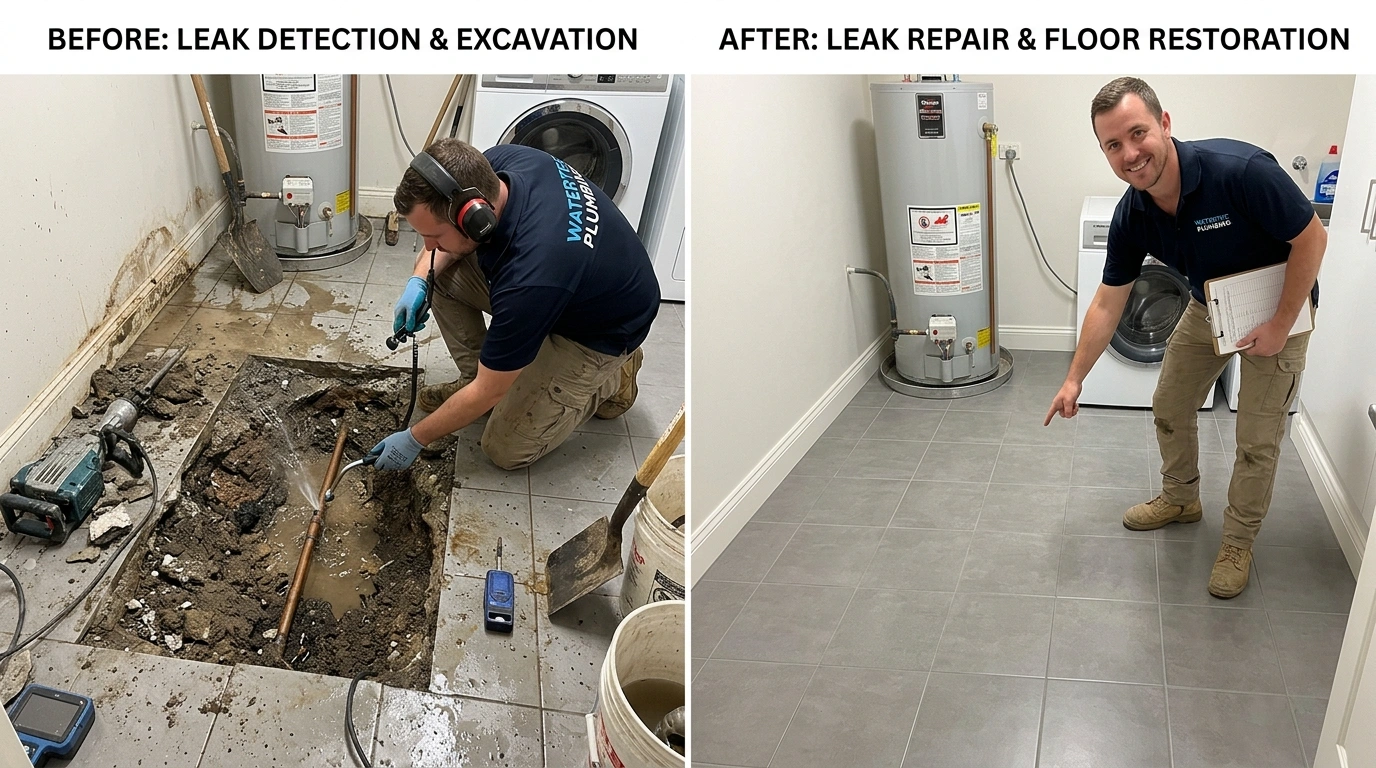
Many property owners contact us after days or weeks of uncertainty: the water bill has increased, a floor area feels warm, the meter appears to move when no water is being used, or moisture keeps returning without an obvious source. A professional inspection helps replace uncertainty with documented observations, diagnostic findings, and a clearer repair path.
Water loss is suspected, but the source is unknown.
Accessible plumbing is inspected, appropriate tests are performed, and the likely source area is explained.
A homeowner worries every warm floor or damp area means the foundation is failing.
Actual plumbing and moisture evidence assessed, with property-specific findings instead of assumptions.
Customer doesn't know if the solution requires direct access, rerouting, repiping, or investigation.
Practical repair options based on diagnosis, pipe condition, access, cost, and long-term reliability.
Moisture threatens flooring, cabinets, walls, or business operations.
Immediate plumbing concern is addressed or stabilized, and appropriate next steps identified.
How We Detect, Diagnose & Plan Repairs for Slab Leaks
Professional tools, plumbing-system evaluation, and property-specific methods for hidden water-line concerns.
Slab leak detection is not a single-device process. The methods used should match the available evidence, pipe configuration, property construction, access conditions, water-use symptoms, and safety requirements. Resort Temec Plumbers selects diagnostic steps based on what will provide the most useful information while minimizing unnecessary disruption.
Identify possible ongoing water use when fixtures are off.
Evaluate the behavior of supply lines under controlled conditions.
Detect sound patterns associated with pressurized water movement.
Temperature differences may help identify potential hot-water line concerns.
Floors, walls, cabinets, water-heater areas, fixtures, and accessible plumbing.
Drain testing or sewer camera inspection for drain-line-related moisture symptoms.
Direct-access repair, water-line rerouting, repiping, or related repair planning.
Restoration, concrete, flooring, drywall, and other qualified trade partners.
No diagnostic method should be represented as a guarantee that every leak can be located without opening a surface. In some cases, limited access, additional testing, or exploratory work may be necessary to confirm the source and complete a lasting repair.
Should You Repair a Slab Leak or Replace the Affected Water Line?
Helping Temecula property owners choose a repair path based on findings, pipe condition, access, cost, and future reliability.
Once a concealed water leak is identified, the best solution depends on the leak location, pipe material, age, condition of the overall system, access requirements, flooring and concrete considerations, history of prior leaks, and the feasibility of rerouting the line.
| Scenario | Direct Repair Recommended | Rerouting / Replacement Recommended |
|---|---|---|
| One isolated leak in otherwise sound piping | Yes, if the leak can be accessed and repaired reliably | Not always necessary unless broader pipe condition is poor |
| Leak beneath accessible area with limited finish disruption | Yes, direct access may be practical | Consider rerouting if access would still be highly disruptive |
| Repeated leaks in aging water lines | Short-term repair may be possible | Often worth evaluating rerouting or broader repiping |
| Corroded, damaged, deteriorating pipe system | Limited repair may address the immediate leak | Replacement or rerouting may offer better long-term reliability |
| Leak beneath premium flooring or cabinetry | Possible, depending on location and repair scope | Rerouting may reduce disruption in some cases |
| Changed plumbing needs during renovation | Repair may be possible | New routing or repiping may support updated layout |
| Multiple water-line concerns across property | Individual repairs may become repetitive | A planned replacement strategy may be more cost-effective |
Rerouting or Replacement May Be Better When:
- The plumbing system has a history of repeated slab leaks or water-line failures
- Pipe material is deteriorated, corroded, damaged, or no longer reliable
- Direct access would require substantial disruption to concrete, flooring, cabinetry
- The affected line can be rerouted through more accessible walls, ceilings, or attics
- A remodel, renovation, or broader plumbing upgrade is already planned
- The long-term cost of repeated spot repairs may outweigh a more durable solution
Slab Leak Detection Costs in Temecula, CA
Clear discussion of diagnostic and repair cost factors before major work begins.
The cost of slab leak detection and repair is not determined by one symptom or one square-foot estimate. Repair costs can vary substantially based on whether the leak is in a supply line, drain line, irrigation line, main water line, wall, ceiling, slab area, or another concealed location.
Main Cost Drivers Include:
- Type and location of the suspected leak
- Property size, layout, plumbing configuration, pipe material, and line accessibility
- Diagnostic time and methods needed to narrow down the source
- Whether the issue involves a hot-water line, cold-water line, main line, drain, irrigation, or fixture connection
- Condition and age of the water-line system
- Direct-access requirements involving flooring, concrete, walls, cabinets, or landscaping
- Repair method: spot repair, rerouting, partial repiping, or whole-home repiping
- Need for water-damage mitigation, drying, restoration, or other trade coordination
- Scheduled service versus urgent or after-hours emergency response
| Service Type | Typical Pricing Consideration |
|---|---|
| Slab Leak Inspection | Depends on symptoms, accessible plumbing, property size, and diagnostic complexity |
| Water-Meter & Pressure Assessment | Depends on system layout and testing required |
| Acoustic / Thermal Leak-Location | Depends on property conditions, equipment use, and investigation time |
| Direct-Access Repair | Depends on leak location, pipe condition, surface access, and repair scope |
| Pipe Rerouting | Depends on line length, routing path, materials, walls/ceilings, fixture reconnections |
| Partial / Whole-Home Repiping | Depends on property size, number of fixtures, pipe selection, access, and restoration |
| Water-Damage Coordination | Depends on moisture extent, materials affected, drying needs, and insurance considerations |
Insurance Note
Homeowners insurance may cover certain sudden and accidental water-damage events, but coverage for the failed pipe, access work, resulting damage, mold, restoration, and related losses depends on the policy, cause of loss, exclusions, deductible, and insurer decision. The California Department of Insurance advises property owners to dry wet areas promptly after sudden water damage and to work with their insurer regarding a claim.
Which Temecula Properties Need a Slab Leak Inspection?
Understanding when hidden-water-loss symptoms call for professional plumbing diagnosis.
A slab leak inspection may be appropriate when your property shows signs of unexplained water use, recurring moisture, possible hot-water loss, or concealed plumbing trouble. You do not need to wait until water visibly comes through the floor to request an evaluation.
You May Need Slab Leak Detection If You Notice:
Slab Leak Detection for Commercial & Multi-Unit Properties
Protect water systems, tenant spaces, customer areas, operations, and building materials across your commercial property.
Commercial slab leaks and concealed water-line leaks can be especially disruptive because they may affect multiple suites, common areas, restrooms, kitchens, mechanical spaces, guest areas, tenant operations, or water-use costs. Businesses need a plumbing partner who can evaluate the leak concern methodically.
Resort Temec Plumbers provides commercial plumbing and hidden-water-leak assessment for eligible businesses throughout Temecula, Riverside County, and surrounding service areas.
| Commercial Service | Description |
|---|---|
| Commercial Leak Detection | Assessment of hidden water loss, meter movement, moisture, pressure concerns |
| Slab Leak Investigation | Diagnosis of potential water-line leaks beneath or near commercial slabs |
| Water-Line Repair Planning | Direct repair, rerouting, partial replacement, or repiping recommendations |
| Commercial Plumbing Inspection | Review of accessible supply lines, fixtures, valves, water heaters, drains |
| Multi-Unit Service Coordination | Scheduling for HOAs, apartment communities, retail centers, offices, campuses |
| Documentation Support | Service findings, repair recommendations, and work documentation |
Commercial Property Types We May Serve:
Benefits of Hiring Licensed Slab Leak Detection Pros in Temecula
Accurate diagnosis, informed repair decisions, reduced water loss, and greater peace of mind.
A hidden plumbing leak can be difficult to diagnose from a single symptom. Professional leak detection helps property owners understand whether the evidence points to a possible slab leak, another plumbing leak, an irrigation issue, a drainage concern, or a non-plumbing moisture source.
Investigate high water bills, water-meter movement, warm flooring, wet spots, pressure changes, and running-water sounds
Evaluate accessible fixtures, valves, water heaters, supply lines, drains, and irrigation before assuming under-slab
Use appropriate diagnostic methods to narrow down the likely source area
Discuss direct repair, pipe rerouting, repiping, and restoration coordination based on actual findings
Reduce ongoing water loss and help limit moisture-related damage to floors, walls, cabinets, and finishes
Receive clear documentation of observations, test results, recommended next steps, and completed work
Get 24/7 emergency support when an active water leak requires immediate plumbing attention
Why DIY Slab Leak Investigation or Repair Can Be Risky
Important reasons to avoid cutting concrete, opening walls, or forcing plumbing components without professional assessment.
Safety First
A suspected slab leak can involve pressurized water lines, electrical systems near moisture, structural finishes, hot-water lines, concrete, flooring, landscaping, and hidden plumbing. Breaking concrete, drilling floors, cutting walls, forcing shutoff valves, or attempting unqualified repairs can create more water damage.
If you suspect a hidden water leak, reduce water use if it is safe to do so. If there is an active leak and you can safely access the local shutoff valve, close it. If the local valve does not work, is damaged, or cannot be accessed safely, use the main water shutoff if appropriate and call a qualified plumber.
Safety Concerns Include:
Answers to Common Slab Leak Detection Questions in Temecula
Quick answers to the questions homeowners, HOAs, and commercial property managers ask most.
How do I know if I have a slab leak under my house?
Possible signs include a high water bill with no visible leak, a moving water meter when water use is paused, water-running sounds, warm spots on flooring, damp carpet, moisture at the base of walls, musty odors, lower water pressure, or unexplained hot-water loss. These signs do not prove a slab leak by themselves; professional diagnosis is needed to identify the source.
Why do I hear water running when everything is turned off?
The sound may indicate water moving through a plumbing line, but the source could be a hidden supply-line leak, a toilet issue, an irrigation system, an appliance connection, or another plumbing component. A technician can inspect the system and use appropriate testing to narrow down the cause.
Why is my water meter moving when all faucets are off?
A moving meter can indicate ongoing water use somewhere on the property. It does not prove that the leak is beneath the slab. Before assuming a slab leak, consider toilets, irrigation, water softeners, appliances, fixtures, visible plumbing, and other water-using equipment. A professional inspection can help isolate the source.
Why is there a warm spot on my tile floor?
A warm spot may be associated with a hot-water line beneath or near the floor, but it can also have other explanations depending on the property. If the warm area is persistent and paired with water-loss symptoms, schedule a professional leak-detection inspection.
Can plumbers find a slab leak without breaking concrete?
Professional methods such as pressure testing, water-line isolation, acoustic listening, thermal assessment, and other diagnostic steps can help narrow down the likely leak area. However, no method can guarantee that every leak will be confirmed or repaired without limited access to concrete, flooring, walls, or other surfaces.
What tools are used for slab leak detection?
Depending on the property and symptoms, plumbers may use water-meter checks, pressure-testing equipment, acoustic listening tools, thermal-imaging or thermal-assessment equipment, moisture tools, plumbing cameras, and other diagnostic methods. The proper combination depends on the situation.
Is a slab leak an emergency?
An active leak, fast-rising water bill, water spreading into flooring or walls, loss of water pressure, water that cannot be shut off, or moisture affecting electrical or commercial operations should be treated as urgent. A small or uncertain symptom may still deserve prompt inspection, but not every suspected slab leak requires an emergency call.
Do I have to leave my house during slab leak repair?
Many repairs can be completed while occupants remain on the property, but this depends on the repair method, water shutoff time, noise, dust, access requirements, flooring work, safety conditions, and restoration scope. Your technician can explain what to expect after diagnosis.
Is direct repair better than rerouting a pipe?
Neither option is always better. Direct repair may be practical for an isolated, accessible leak in otherwise reliable piping. Rerouting may be preferable when pipe condition is poor, leaks are recurring, or concrete/floor access would be especially disruptive. The best decision follows diagnosis.
Does homeowners insurance cover slab leak damage in California?
Coverage depends on the policy, the cause and duration of the leak, exclusions, deductible, and insurer decision. California homeowners policies may cover some sudden and accidental water-damage events, but coverage for the broken pipe, access work, flooring, mold, and restoration can vary. Review your policy and contact your insurer for guidance.
What should I do while waiting for a leak-detection plumber?
Reduce water use if safe, move belongings away from moisture, take photos of visible damage, note meter readings and symptoms, avoid breaking concrete or opening walls, and turn off the local or main water supply if an active leak cannot be controlled safely.
You're Supported from First Inspection to a Clear Repair Plan
Local experience, practical diagnosis, transparent recommendations, and responsive plumbing support.
Resort Temec Plumbers understands that a suspected slab leak creates uncertainty about your water bill, flooring, foundation, home, business, and repair costs. Our team approaches the issue with careful evaluation, professional diagnostic methods, and a clear explanation of the repair paths supported by the findings.
We do not use one-size-fits-all solutions. Whether the issue involves an under-slab water line, a wall leak, a water-main concern, an irrigation issue, a failing fixture connection, a drain line, or another concealed plumbing source, our goal is to help you understand what is happening and what practical next step makes sense.
Service Commitment
If you have a question about the findings, recommended repair approach, or completed work, contact Resort Temec Plumbers promptly. We will review the available service information, evaluate the concern, and explain appropriate next steps in line with the documented scope, applicable workmanship terms, and manufacturer coverage where relevant.
45895 Parsippany Ct
Temecula, CA 92592
United States
Licenses & Qualifications That Support Slab Leak Detection
Credentials that matter when investigating concealed plumbing, pressurized water lines, and repair options.
Slab leak detection and repair involve plumbing-system knowledge, water-line diagnostics, pressure behavior, concealed pipe locations, access considerations, repair planning, and applicable construction requirements. The California Contractors State License Board identifies C-36 as the Plumbing Contractor classification.
Emergency Slab Leak Detection in Temecula, CA
Rapid response when active water loss, spreading moisture, or an uncontrolled plumbing leak puts your property at risk.
A suspected slab leak becomes more urgent when water is actively spreading, the water meter continues moving during no-use periods, water pressure drops suddenly, moisture reaches flooring or walls, a water line cannot be shut off, or commercial operations are affected. Resort Temec Plumbers offers 24/7 emergency plumbing support for qualifying active leaks.
Emergency Response Process:
Immediate phone consultation to assess symptoms, water loss, property risk, and urgency
Guidance on safely reducing water use and shutting off local or main water valves
Dispatch of a qualified technician with diagnostic and plumbing repair equipment
On-site inspection of accessible plumbing, moisture conditions, and likely leak sources
Diagnostic testing, temporary mitigation, repair planning, or emergency plumbing work
Documentation for property records, restoration coordination, and insurance
Emergency Scenarios Include:
Insurance Claim Assistance for Slab Leak & Water-Damage Incidents
Plumbing documentation that may help you communicate with your insurer after a water-loss event.
When a hidden plumbing leak contributes to water damage, property owners may need to document the incident, visible moisture, plumbing findings, repair recommendations, and completed work. Resort Temec Plumbers can provide documentation related to the plumbing inspection, diagnostic findings, and authorized repair work.
Available Documentation May Include:
Policy Note
Do not assume a slab leak is covered. Some homeowners policies may provide coverage for certain sudden and accidental water-damage events, while long-term seepage, maintenance-related issues, mold, the failed pipe itself, access work, and restoration may be subject to exclusions or limits. Review your policy and speak with your insurer, agent, or qualified claims professional.
Warranty Coverage for Slab Leak Detection, Repair & Rerouting
Clear information about workmanship, materials, and applicable manufacturer coverage.
Warranty coverage for slab leak-related work depends on the specific diagnosis, repair method, pipe material, access conditions, existing plumbing condition, scope of work, installed components, and written service agreement. Resort Temec Plumbers should explain the warranty terms applicable to your particular project before major repair work is approved.
| Coverage Type | Description |
|---|---|
| Diagnostic Service | Covers documented scope of inspection and testing performed; findings may be limited by property conditions |
| Workmanship | May apply to qualifying labor for authorized repair, rerouting, or installation |
| Pipes, Fittings, Materials | New materials may carry manufacturer warranties, subject to product-specific conditions |
| Documentation | Invoices, service records, repair descriptions, and applicable warranty details |
| Exclusions / Limitations | Pre-existing conditions, unrelated failures, soil movement, external damage, corrosion beyond repair area |
Important Notes
- Warranty details should be documented in writing for the specific scope of work.
- A warranty on one repaired section does not guarantee the condition of unrelated aging plumbing lines.
- Manufacturer warranties differ by product, pipe material, installation environment, and registration requirements.
- Ask about applicable workmanship and manufacturer warranty terms before approving major repair or repiping work.
10 Fully Equipped Vehicles Serving Temecula & the Inland Empire
Diagnostic equipment, repair tools, and skilled professionals prepared for hidden water-leak investigations.
Resort Temec Plumbers operates with 10 fully equipped service vans to support scheduled leak-detection appointments and urgent plumbing calls in Temecula and eligible surrounding areas.
Flexible Payment Options for Slab Leak Repair & Repiping Projects
Helping property owners plan for major water-line repairs, rerouting, repiping, and restoration-related plumbing work.
A diagnostic visit or minor repair may not require financing, but larger slab leak projects can involve direct-access work, pipe rerouting, partial repiping, whole-home repiping, water-line replacement, restoration coordination, or multiple plumbing upgrades. Resort Temec Plumbers can discuss available payment or financing options for qualifying projects.
Financing or Payment-Plan Discussions May Be Helpful For:
Ask for current information about eligibility, lender participation, interest rates, fees, repayment terms, and project requirements before making a financing decision.
Recognition for Plumbing Service Excellence
Awards and professional recognition should reflect verified quality, credentials, and service to the local community.
Angi Certified
Gold Award recognition
Best of the Valley
Plumbing Company Category
PHCC Contractor
Plumbing Contractor of the Year
Quality Business Award
Service excellence recognition
Top Rated Local Plumber
Community-verified quality
Senior & Military Discounts on Slab Leak Detection & Repair
Supporting qualifying customers with available plumbing-service offers when a hidden leak needs attention.
Resort Temec Plumbers may offer promotions for qualifying senior citizens, active military personnel, veterans, teachers, first-time customers, or other eligible customers. Discount availability, dollar amount, excluded services, emergency-service limitations, financing interactions, and current terms should be confirmed when scheduling.
Slab Leak Detection Hours in Temecula, CA
24/7 availability for active water leaks, emergency plumbing, and urgent hidden-water-loss concerns.
| Day | Hours |
|---|---|
| Monday | 00:00 – 23:59 |
| Tuesday | 00:00 – 23:59 |
| Wednesday | 00:00 – 23:59 |
| Thursday | 00:00 – 23:59 |
| Friday | 00:00 – 23:59 |
| Saturday | 00:00 – 23:59 |
| Sunday | 00:00 – 23:59 |
Contact Resort Temec Plumbers
Phone: (951) 793-0002
Email: resorttemecplumbers@gmail.com
Website: emergencyplumbingtemecula.com
Emergency: 24/7 for urgent active leaks
Resort Temec Plumbers vs. Typical Slab Leak Detection Providers
What to look for when choosing a plumbing professional for hidden water loss, slab leaks, water-line repair, or rerouting.
Not every provider approaches a suspected slab leak with the same diagnostic process, repair capability, communication standards, availability, or service capacity. When choosing a slab leak plumber, look for a provider who investigates the actual symptoms, considers visible and accessible plumbing sources, explains the limits of testing, and provides repair options after the findings are clear.
| Feature | Resort Temec Plumbers | What to Confirm with Any Provider |
|---|---|---|
| Local Service Focus | Temecula-based with broader regional coverage | Whether they genuinely serve your address in needed timeframe |
| Experience & Capacity | 30+ years, 50 professionals, 10 service vans | Years in business, technician qualifications, staffing, availability |
| Diagnostic Approach | Reviews symptoms, plumbing, meter, pressure, moisture | Whether provider explains process and avoids assumption-based conclusions |
| Repair Capabilities | Repair planning, water-line repair, rerouting, repiping, drains, fixtures | Whether provider supports the needed repair path |
| Emergency Availability | 24/7 for qualifying urgent water leaks | Whether after-hours service is available and emergency charges |
| Communication | Clear findings, repair options, scope discussion | Whether cost drivers, access needs, warranty terms are explained |
| Commercial Support | Eligible commercial, HOA, multi-unit properties | Whether provider can coordinate access, tenants, phased work |
The best plumbing provider is one that evaluates the property carefully, communicates honestly, uses suitable diagnostic tools, explains repair options without pressure, and helps you make a decision based on the actual condition of the plumbing system.
Contact Resort Temec Plumbers for Slab Leak Detection in Temecula, CA
Talk with a plumbing professional today about water-running sounds, high bills, warm floors, moisture, low pressure, or a suspected leak under your slab.
If you hear water running when everything is off, notice a water meter moving during no-use periods, see moisture at the base of a wall, find a warm spot on your floor, experience a sudden high water bill, smell mildew, have wet carpet with no clear cause, or suspect water leaking beneath your concrete slab, Resort Temec Plumbers is ready to help.
Contact Details
Temecula, CA 92592
Riverside County, Inland Empire
Hours of Operation
Request an Online Leak Assessment
Protect your property, plumbing system, flooring, walls, and water budget with professional service.