Professional Water Filtration Repair & Replacement in Temecula, CA
Water Treatment System Repair Temecula — Fast, Licensed & Available 24/7
Temecula Valley water filtration service for hard-water scale, leaking systems, slow RO faucets, and outdated equipment. When you need water filtration repair Temecula CA homeowners, property managers, and local businesses can rely on, Resort Temec Plumbers helps identify the actual issue before recommending a costly replacement.
We repair and replace whole-house water filters, under-sink drinking-water filters, reverse-osmosis systems, filter housings, cartridges, fittings, pressure tanks, water softeners, and related water-treatment equipment.
- Whole-house water filter repair & installation
- Reverse-osmosis repair for low pressure & leaks
- Water softener service for scale & salt issues
- Commercial water filtration support
- 30+ years serving Temecula (Est. 1990)
- California C-36 Licensed & Insured
Request Water Filtration Service
Fill out the form and our team will contact you promptly!
Senior, Military & Teacher Discounts AvailableWater Filtration Services Backed by 30+ Years of Experience
Inland Empire water filtration repair from a local plumbing team focused on clear answers and reliable system performance.
Water-treatment equipment can fail in ways that are frustrating but not always obvious. A slow reverse-osmosis faucet may involve a dirty filter, membrane condition, restricted line, pressure tank, valve, feed-water pressure, or another component. A water filter leak may come from a damaged housing, loose connection, worn O-ring, incorrect cartridge, cracked fitting, or pressure-related issue. A water softener that is not working may have a salt bridge, regeneration issue, control-valve concern, resin problem, bypass issue, or an aging component.
Resort Temec Plumbers evaluates the system and the symptom before recommending a solution. We do not assume that a slow RO faucet means the full unit needs replacement or that white scale automatically requires a one-size-fits-all system. Our goal is to help you understand your existing equipment, available repair options, and whether an upgrade would provide better long-term value.
Water Filtration Repair Near Temecula Neighborhoods, Homes & Business Hubs
Serving Temecula Valley water-treatment and commercial plumbing customers near Old Town, Wine Country, Pechanga, and surrounding communities.
Water quality preferences and hard-water concerns are common across Temecula Valley. From homes near Old Town Temecula to properties in Redhawk, Harveston, Morgan Hill, Paloma del Sol, Paseo del Sol, Crowne Hill, Meadowview, and the Vail Ranch area, homeowners often call for help with white scale, water spots, slow filtered-water flow, RO leaks, or water-softener issues.
Resort Temec Plumbers also supports water-filtration and water-treatment needs for restaurants, wineries, tasting rooms, hospitality properties, offices, rental homes, HOAs, and commercial plumbing clients. Reliable treatment equipment can support better drinking-water convenience, ice and beverage quality, equipment protection, fixture maintenance, and day-to-day operations.
Temecula Neighborhoods
Redhawk, Harveston, Morgan Hill, Paloma del Sol, Paseo del Sol, Rancho Highlands, Crowne Hill, Meadowview, De Luz, and Vail Ranch.
Nearby Communities
Murrieta, French Valley, Winchester, Menifee, Wildomar, Lake Elsinore, Hemet.
Regional Hubs
Old Town Temecula, Temecula Valley Wine Country, Pechanga area, Vail Headquarters, Rancho California Road, and De Portola Wine Trail.
Specialized Water Filtration Repair for RO, Whole-House & Softener Systems
Temecula water-treatment specialists for reverse osmosis, water softeners, filter housings, pressure tanks, and whole-house systems.
A water filter, water softener, reverse-osmosis system, and whole-house water-treatment system are not the same thing. Each uses different components and is designed for different goals. A water softener is generally used to reduce hardness minerals that contribute to scale. A whole-house filter may address particles, taste, odor, or other selected concerns depending on its media and design. A reverse-osmosis system is commonly installed at a point of use, such as a kitchen sink, to produce treated drinking water.
Resort Temec Plumbers helps property owners understand what equipment they have and why it may not be performing as expected. Whether you are searching for reverse osmosis repair Temecula, whole-house filter service, or water-softener troubleshooting, we assess the system instead of treating every concern as a simple filter change.
What Happens When a Water Filtration System Fails in Temecula?
Common water-treatment problems Temecula property owners face—and why the right diagnosis matters.
Water-filtration and softening issues can appear gradually. You may notice white spots on glasses, scale on faucets, a shower door that is harder to clean, soap that does not rinse well, or a tankless water heater that needs more frequent maintenance. You may also notice immediate symptoms: water leaking under the sink, an RO faucet producing only a trickle, filtered water that tastes different, a water softener that is not using salt, or a system that continuously sends water to the drain.
A water-treatment problem does not always mean the entire system has failed. Many systems can be restored with the correct cartridge, membrane, O-ring, fitting, pressure-tank, valve, tubing, resin, control, or housing repair. When equipment is obsolete, repeatedly leaking, unsupported, poorly sized, or no longer meeting the property's needs, replacement may be the smarter long-term option.
Slow or no water from a reverse-osmosis faucet
RO systems that leak, make noise, or fail to shut off
Whole-house filters with low pressure or cracked housings
Water softeners not using salt or not regenerating
Bad taste, odor, cloudiness, or noticeable water change
White chalky residue on dishes, faucets, shower glass
Scale affecting dishwashers, ice makers, and appliances
Outdated equipment with unavailable parts
Prevent Water Filtration Problems with Routine Maintenance
What Temecula homes and businesses need to keep filters, RO systems, and softeners working reliably.
Water-treatment systems need periodic maintenance, but the proper schedule depends on the specific manufacturer, equipment type, water use, incoming water condition, filter media, membrane condition, and plumbing configuration. There is no single replacement schedule that fits every system.
Many reverse-osmosis systems need periodic sediment, carbon, and post-filter service, while membranes may have a longer replacement cycle. Whole-house filter cartridges need replacement according to their type, water conditions, and flow demand. Water softeners may need salt monitoring, brine-system checks, cleaning, and component service depending on performance and manufacturer instructions.
| Task | Description | Typical Timing | Practical Impact |
|---|---|---|---|
| Filter cartridge inspection | Review sediment, carbon, or specialty filters | Per manufacturer guidance | Maintains flow and performance |
| RO prefilter/post-filter service | Replace filters per usage & system needs | Often 6–12 months | Protects membrane & drinking-water flow |
| RO membrane assessment | Evaluate membrane condition | Varies by system & feed water | Determines service need |
| Pressure-tank & flow review | Check low-flow concerns and tank function | When faucet flow declines | Identifies pressure-related issues |
| Whole-house filter inspection | Check housings, O-rings, fittings, pressure | Based on use & media type | Prevents leaks and restriction |
| Water-softener service | Salt, brine, regeneration, controls, resin | As needed or planned service | Reduces hard-water symptoms |
| Documentation & planning | Repairs, compatible parts, maintenance, replacement | During service | Helps owners plan confidently |
Maintenance Best Practices
- Follow your system manufacturer's recommended maintenance schedule whenever possible.
- Schedule service if RO water flow drops, filter housings leak, a softener stops using salt, or white scale returns.
- Replace cartridges and membranes based on system needs rather than waiting for problems.
- Keep records of filter changes, repairs, equipment models, and warranty information.
Who Needs Water Filtration Repair & Replacement in Temecula?
From Temecula Valley homes to restaurants, wineries, rental properties, and commercial facilities.
Water-treatment needs vary from property to property. A family may want better-tasting kitchen water and fewer hard-water spots. A landlord or HOA may need to protect fixtures and reduce recurring maintenance issues. A restaurant, winery, coffee shop, hotel, or commercial kitchen may depend on water treatment to support beverage quality, ice machines, equipment performance, and day-to-day operations.
Resort Temec Plumbers assists customers who need help repairing an existing system, maintaining equipment, choosing replacement components, or planning a water-treatment upgrade.
Residential
Single-family homes with water softeners, RO systems, whole-house filters, or under-sink filters.
Rentals & HOAs
Rental homes, landlords, apartment properties, multi-family communities, and HOAs.
Food & Beverage
Restaurants, cafes, coffee shops, wineries, tasting rooms, and food-service facilities.
Hospitality
Hotels, resorts, hospitality properties, and guest-oriented venues.
Commercial
Offices, retail spaces, mixed-use properties, and commercial buildings.
Medical & Professional
Medical offices, dental practices, clinics, and professional facilities.
Community
Schools, churches, community centers, and nonprofit properties.
Industrial
Warehouses, light-industrial properties, and commercial plumbing clients.
How Inland Empire Water Conditions and Usage Impact Filtration Systems
Hard-water minerals, warm conditions, and daily demand can affect filters, softeners, fixtures, and appliances.
Many Temecula-area property owners seek water treatment because of hard-water symptoms such as white residue, mineral scale, water spots, reduced soap performance, and buildup on fixtures or appliances. Hardness generally refers to dissolved minerals, including calcium and magnesium. It is different from a conclusion that water fails drinking-water standards.
Rancho California Water District states in its 2024 Consumer Confidence Report that its water supply met applicable U.S. EPA and California drinking-water standards. Customers may still choose water filtration, reverse osmosis, or water softening to meet personal preferences, address a water-test result, reduce scale effects, improve taste or odor, or protect water-using equipment.
Common Water Treatment Systems Used in Temecula & the Inland Empire
Understanding the difference between water filters, softeners, reverse osmosis, and related equipment.
The right repair or replacement begins with identifying what the system is designed to do. A water softener is commonly used to reduce hardness minerals; it does not function the same way as an RO system. A reverse-osmosis unit typically treats drinking water at one faucet. A whole-house filter may use sediment, carbon, or other media depending on the property's goals and the equipment installed.
| System or Component | Typical Purpose | Common Concern | Service Focus |
|---|---|---|---|
| Whole-house sediment filter | Captures particles before household plumbing | Low pressure, dirty cartridge, leaks | Cartridge, housing, O-ring, fitting |
| Whole-house carbon filter | May improve taste and odor | Taste/odor concern, maintenance | Media/system evaluation |
| Under-sink drinking filter | Filters at kitchen/drinking faucet | Slow flow, leaks, cartridge changes | Cartridge, tubing, faucet, housing |
| Reverse-osmosis system | Point-of-use membrane treatment | Low flow, leaks, constant drain | Filters, membrane, tank, valves, lines |
| RO storage tank | Stores treated water for RO faucet | Tank full but faucet has little water | Tank pressure, bladder, connections |
| Water softener | Reduces hardness through ion exchange | White scale, salt not being used | Brine system, resin, control valve |
| UV treatment system | Uses ultraviolet light | Lamp, sleeve, power, maintenance | System-specific service |
| Bypass & control valves | Direct water through/around equipment | System bypassed, leaking | Valve, fitting, control repair |
Our 6-Step Water Filtration Repair & Replacement Process
What to expect when Resort Temec Plumbers visits your Temecula property.
Initial Call & Symptom Review
Tell us what you are experiencing: low RO water pressure, leaking filter housing, softener issues, poor taste, white scale, or a system needing replacement.
On-Site Equipment Identification
Our technician reviews visible equipment, model information, plumbing connections, system layout, reported symptoms, and accessible components.
System Diagnostic Evaluation
We inspect relevant filters, housings, O-rings, fittings, tubing, valves, pressure tanks, softener components, and plumbing connections.
Clear Repair or Replacement Options
We explain findings in plain language. If component-level repair is practical, we outline it. If equipment is outdated, we explain replacement considerations.
Approved Service or Installation
After approval, we complete authorized repair work or develop a plan for larger water-filtration replacement or commercial water-treatment upgrades.
Testing, Cleanup & Guidance
We test completed work, review system operation, explain recommended maintenance steps, and provide applicable service or warranty information.
What's Included in Our Water Filtration Repair & Replacement Service
Clear deliverables for Temecula homeowners, property managers, and commercial plumbing customers.
Every water-treatment service call is different. A filter cartridge change is not the same as diagnosing a leaking RO system, repairing a water softener, replacing a whole-house filter housing, or installing a new water-treatment system. Resort Temec Plumbers explains the service scope before major work begins so you understand the problem, your options, and what approved work includes.
Key Advantages of Working with Resort Temec Plumbers
Practical diagnostics, locally relevant water-treatment support, and straightforward options.
Water-treatment service should be based on your equipment, your property, your water-use patterns, and your goals—not a high-pressure pitch for a system you may not need. Resort Temec Plumbers helps customers understand what is wrong and what will provide the most practical next step.
Water Filtration Repair & Replacement Transformations for Temecula Properties
What changes when water-treatment equipment is properly diagnosed, repaired, and maintained.
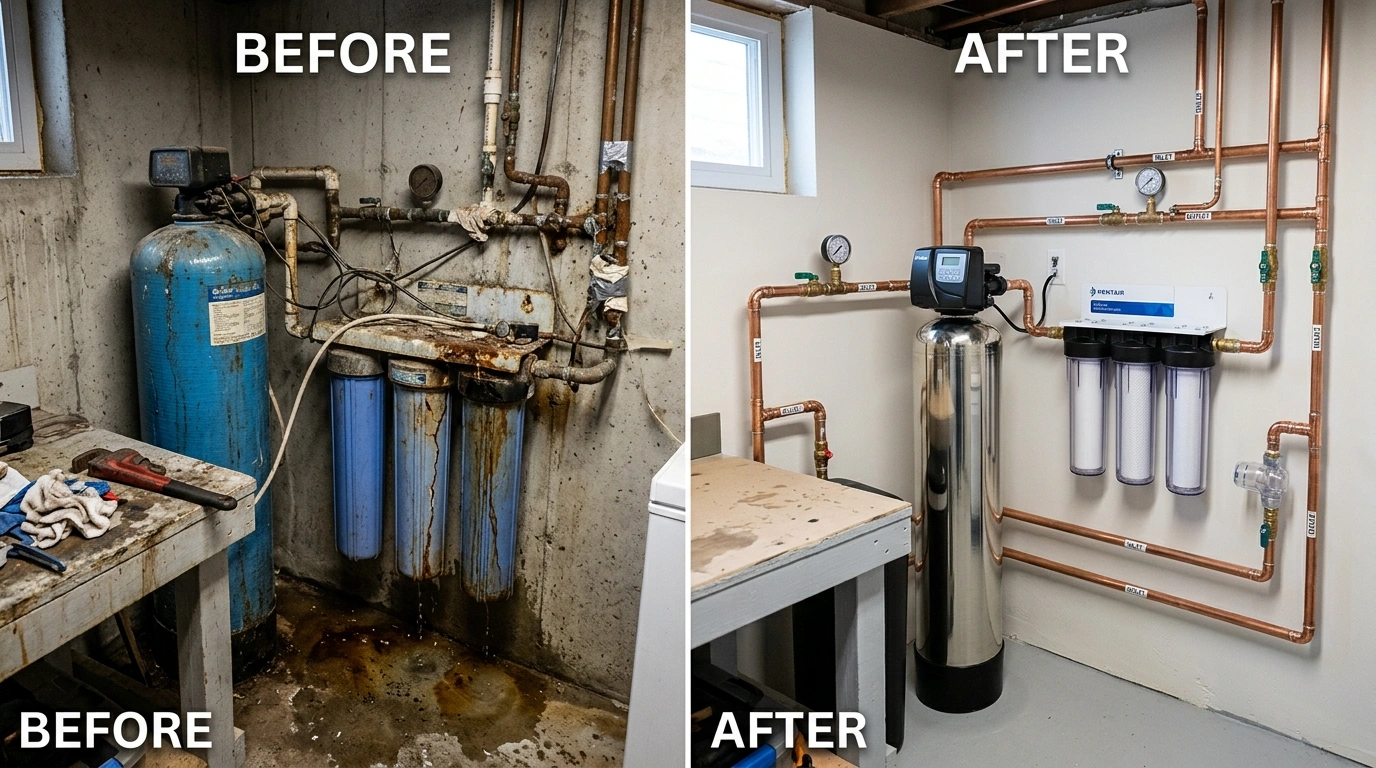
Many customers start with uncertainty. They see white scale on fixtures, have an RO faucet that barely flows, discover water under the sink, or notice that the softener salt level never changes. The right solution may be simple maintenance, a component repair, or a full replacement—but that decision should be based on the actual condition of the system.
Filtered drinking water comes out slowly or not at all.
AfterThe system is evaluated for filter, membrane, tank, pressure, line, valve, or connection issues and a practical solution is recommended.
A whole-house filter housing drips or leaks after a cartridge change.
AfterAccessible housings, O-rings, fittings, cartridge fit, and pressure-related conditions are assessed for repair or replacement.
White scale and water spots continue to affect faucets, shower doors, dishwashers, and appliances.
AfterThe softener or water-treatment system is evaluated against the property's water-use and hardness-management goals.
An old water-treatment system has unclear maintenance history or unavailable parts.
AfterThe owner receives clear repair-versus-replacement guidance and a system plan appropriate to the property.
How We Repair, Replace & Install Water Filtration Systems
Quality components, compatible replacements, and careful plumbing workmanship in Temecula.
Resort Temec Plumbers approaches water-filtration service as a plumbing and equipment project. The correct solution may involve replacing a cartridge, membrane, O-ring, filter housing, fitting, line, pressure tank, valve, bypass component, softener resin, or control assembly. In other cases, it may be more reliable to replace outdated equipment with a correctly selected new system.
Before recommending major water-treatment equipment, we consider visible system condition, available model information, replacement-part compatibility, plumbing layout, water pressure, household or commercial demand, installation space, and the customer's goals. We do not claim that one filter, softener, or RO system is right for every Temecula property.
Should You Repair a Water Filtration System or Install a New One?
Clear water-treatment repair-or-replace guidance for Temecula property owners.
Not every water-filtration issue requires a new system. Many performance problems are caused by serviceable components such as filter cartridges, membranes, O-rings, fittings, tubing, tanks, valves, controls, or water-softener parts. Replacement may be the wiser choice when equipment is badly damaged, repeatedly leaking, obsolete, unsupported, poorly sized, or unable to meet the property's current needs.
| System Condition | Repair May Be Recommended | Replacement May Be Recommended |
|---|---|---|
| Dirty or overdue filter cartridge | Yes, if housing & system are in good condition | Usually not necessary for routine change |
| Low RO faucet flow | Yes, when filters, membrane, tank pressure, or valves can be restored | Considered if system is obsolete or unsupported |
| Leaking O-ring, fitting, or connection | Yes, when housing & components are sound | Considered if housing is cracked or degraded |
| Water-softener salt bridge or brine issue | Yes, when controls, resin, tank are serviceable | Considered for major component failure |
| Worn softener resin or failed control valve | Sometimes, depending on age & cost | When repairs approach the value of a new system |
| Cracked whole-house filter housing | Usually requires housing replacement | Complete upgrade if system is old |
| Unavailable parts or unsupported equipment | Limited repair options may remain | Often a strong reason to plan replacement |
Replacement may be recommended when:
- The equipment is cracked, severely corroded, repeatedly leaking, or structurally damaged
- Key filters, membranes, tanks, valves, controls, or replacement parts are obsolete or unavailable
- The system repeatedly loses pressure, drains continuously, bypasses treatment, or fails to deliver reliable performance
- The water softener no longer manages hardness effectively despite appropriate maintenance and repairs
- The system is poorly sized for household demand, a larger property, a commercial operation, or updated plumbing needs
- A replacement system offers a more reliable long-term match for the property's goals
Water Filtration Repair & Replacement Costs in Temecula, CA
Clear cost drivers for water filters, reverse osmosis, softeners, and complete treatment systems.
Water-treatment costs vary because equipment and problems vary. Replacing a filter cartridge is different from repairing an RO pressure tank, addressing a leaking housing, servicing a water-softener control valve, replacing a membrane, or installing a new whole-house treatment system. Resort Temec Plumbers explains the expected scope and provides clear pricing for authorized work before major repairs or replacement projects begin.
| Service Type | Typical Cost Considerations |
|---|---|
| Water-filtration diagnostic visit | System type, symptoms, access, visible components, troubleshooting time |
| Filter cartridge or membrane replacement | Compatibility, filter type, membrane type, housing condition, complexity |
| RO repair | Pressure tank, filters, membrane, shutoff/check valves, flow restrictor, lines, fittings, leaks |
| Whole-house filter repair | Housing condition, O-rings, fittings, pressure, filter media, access |
| Water-softener repair | Control valve, resin, brine system, bypass, leaks, regeneration, parts availability |
| Water-treatment system replacement | System type, demand, location, plumbing modifications, filters/media, capacity |
| Commercial water filtration | Equipment size, volume, operations, water use, beverage/ice equipment, scheduling |
Main Cost Drivers Include:
- Whether the issue involves a cartridge, membrane, fitting, housing, tank, valve, tubing, resin, control, or full system
- Brand, model, equipment age, and compatible replacement-part availability
- Whole-house, under-sink, reverse-osmosis, softener, UV, or commercial water-treatment configuration
- Leaks, low pressure, constant drain flow, water-quality preferences, or hard-water management needs
- Installation access in kitchens, garages, utility rooms, exterior areas, or commercial mechanical spaces
- Property size, household demand, fixture count, commercial use, and treatment capacity
For a clear water filtration replacement Temecula CA estimate, call +1 (951) 793-0002 to schedule an on-site system evaluation.
Which Temecula Properties May Need Water-Treatment Service?
Find out when a filter change, RO repair, softener service, or full equipment upgrade may help.
Water-treatment service is useful when the system is leaking, performing poorly, overdue for maintenance, or no longer matching the property's needs. It can also be useful when you are unsure whether you need water filtration, water softening, reverse osmosis, a whole-house solution, or a combination of systems.
You may benefit from professional water-treatment service if you have:
White scale, mineral spots, soap residue, or recurring buildup on fixtures
An RO faucet with low flow, no water, poor taste, or leaking tank
Whole-house filter with cracked housing, leaking cartridge, or pressure drop
Water softener not using salt, not regenerating, or leaking
Brine tank full of water, possible salt bridge, or malfunctioning control valve
Filtered water that tastes different, smells unusual, or appears cloudy
Older water-treatment system with unclear maintenance history
Restaurant, winery, hotel, HOA, or business with treatment equipment issues
Need to protect tankless water heaters, dishwashers, and appliances
Commercial Water Filtration Repair for Temecula & Riverside County Properties
Help protect equipment, beverage quality, guest experience, and day-to-day operations.
Commercial water-treatment equipment can affect more than drinking water. For restaurants, coffee shops, wineries, tasting rooms, hotels, offices, medical facilities, apartment communities, and commercial kitchens, filtration and softening may influence beverage taste, ice quality, fixture maintenance, scale control, equipment performance, and routine maintenance costs.
Resort Temec Plumbers provides commercial plumbing support for businesses and property managers who need help diagnosing, repairing, maintaining, or replacing water-filtration and water-treatment systems.
| Commercial Water-Treatment Service | Description |
|---|---|
| Commercial water filtration diagnostics | Assess system performance, leaks, flow, filters, connections, housings |
| Filter and cartridge replacement | Replace compatible commercial filter elements per equipment needs |
| Water-softener service | Evaluate brine, control valves, resin, bypass components, leaks |
| Reverse-osmosis service | Filters, membranes, pressure tanks, lines, valves, fittings, flow |
| Whole-house treatment replacement planning | Capacity, demand, plumbing layout, space, access for larger upgrades |
| Commercial plumbing coordination | Water lines, valves, fixtures, leaks, drainage, broader plumbing work |
Commercial Properties We Assist Include:
Food Service
Restaurants, cafes, coffee shops, commercial kitchens.
Wineries
Wineries, tasting rooms, Wine Country venues.
Hospitality
Hotels, resorts, event venues.
Office & Retail
Office buildings, retail spaces, mixed-use properties.
HOAs & Multi-Unit
HOAs, apartment communities, managed properties.
Professional
Medical offices, clinics, schools, churches.
| Commercial Need | Typical Planning Considerations |
|---|---|
| Restaurant or coffee shop | Beverage/ice equipment, filter intervals, flow, taste, operating hours |
| Winery or tasting room | Guest experience, fixtures, kitchen/bar, water demand, equipment protection |
| Hotel or hospitality property | Guest rooms, laundry, kitchen, ice machines, appliances |
| HOA or multi-unit property | Shared equipment, unit count, access, maintenance, replacement planning |
| Commercial facility | Water demand, equipment type, pressure, capacity, service timing |
Benefits of Hiring Licensed Water Filtration Professionals in Temecula
Better diagnostics, compatible repairs, reliable flow, and water-treatment solutions that match your goals.
A water-treatment system works best when the equipment is correctly matched to its purpose and maintained with compatible components. Professional service can help determine whether a low-flow issue is a filter, membrane, tank, valve, line, pressure, or plumbing problem. It can also help clarify whether hard-water symptoms are best addressed by softening, filtration, equipment maintenance, or another approach.
Why DIY Water Filtration Repairs Can Cause Leaks and Damage
Protect your kitchen, garage, utility area, and plumbing system with professional water-treatment service.
DIY Water Filtration Warning
Replacing a simple filter cartridge may be manageable when you follow manufacturer instructions. However, persistent leaks, cracked housings, high-pressure concerns, RO tank issues, damaged fittings, whole-house modifications, electrical equipment, UV components, water-softener controls, and plumbing connections should be handled by a qualified professional.
A poorly seated O-ring, cross-threaded housing, incorrect cartridge, damaged fitting, overtightened connection, or misconfigured bypass can cause leaks, poor performance, water damage, or loss of treatment.
If you have an active water leak, shut off the local supply valve only if safe, then call Resort Temec Plumbers for assistance.
Answers to Common Water Filtration Questions in Temecula
Quick answers about hard water, RO systems, leaks, low pressure, filter changes, and replacement decisions.
Does Temecula have hard water?
Temecula-area water is commonly described as hard in district reports and local water-treatment discussions. Hardness generally refers to dissolved minerals, such as calcium and magnesium, that can contribute to white scale, water spots, fixture buildup, and appliance-maintenance concerns. Hardness can vary by address, supply source, and conditions, so property-specific testing is the best way to understand your water.
Is hard water unsafe to drink?
Hard water is not the same as water that fails drinking-water standards. Rancho California Water District states that its 2024 water supply met applicable U.S. EPA and California drinking-water standards. Many customers choose a softener or filter to reduce scale, improve taste or odor preferences, protect appliances, or meet a property-specific water-treatment goal.
Why is my reverse-osmosis water pressure low?
Low RO flow may be related to overdue filters, a membrane issue, low incoming water pressure, a storage-tank problem, low tank air pressure, a damaged tank bladder, restricted tubing, a kinked line, a flow-restrictor concern, or a shutoff/check-valve issue. A professional diagnostic can identify the likely cause before you replace parts.
Why is my water filter leaking after I changed the cartridge?
A leak can result from a damaged, dry, incorrectly seated, or wrong-sized O-ring; a cracked or cross-threaded housing; an incompatible cartridge; a loose fitting; or pressure-related stress. Turn off the water supply if safe, and have persistent leaks assessed before they cause water damage.
How often should reverse-osmosis filters be changed?
There is no universal schedule. Many systems need sediment, carbon, and post-filter service approximately every 6–12 months, while RO membranes may have a longer service interval. The correct timing depends on the manufacturer, usage, water conditions, incoming pressure, and the specific equipment. Follow manufacturer instructions and professional service guidance.
Why is my RO system constantly draining?
An RO system normally sends some water to a drain during operation, but continuous draining after the storage tank is full may point to a flow restrictor, drain-line, automatic shutoff valve, check valve, pressure, or tank issue. The system should be evaluated before parts are replaced.
Why is my water softener not using salt?
Possible causes include a salt bridge, brine-tank issue, blocked injector, control-valve problem, regeneration fault, bypass setting, resin issue, or another equipment concern. The appropriate repair depends on the softener's design and condition.
Do I need a water softener, whole-house filter, or reverse-osmosis system?
They serve different goals. A softener primarily reduces hardness minerals. A whole-house filter may address particles, taste, odor, or other selected concerns depending on the installed media. A reverse-osmosis system is typically used for point-of-use drinking water. The right option depends on your water-use goals, system layout, existing equipment, and a current water test when appropriate.
Can a water filtration system be repaired?
Often, yes. Cartridges, membranes, O-rings, housings, fittings, tubing, pressure tanks, valves, bypasses, softener resin, controls, and other components may be repairable or replaceable. Full replacement may be better when the system is obsolete, badly damaged, repeatedly leaking, unsupported, or unable to meet the property's needs.
Do you provide emergency water-filter repair?
Resort Temec Plumbers provides 24/7 plumbing availability for active water leaks and urgent plumbing concerns involving water-filtration equipment. Call +1 (951) 793-0002 if a leaking filter, housing, connection, or treatment-system component is causing immediate property-risk concerns.
Clear Answers from First Inspection to Long-Term Water-System Performance
Local plumbing expertise, straightforward recommendations, and responsive water-treatment support.
Resort Temec Plumbers is committed to helping Temecula property owners understand their water-treatment equipment and select a practical solution. We explain the observed system condition, the likely repair options, and the circumstances that may make replacement a better long-term choice.
Water filtration, RO, and softener performance depend on the condition of the equipment, compatible replacement parts, incoming water pressure, filter-maintenance history, water use, system design, and property conditions. We do not promise that one repair or one type of system will meet every water-quality preference or solve every issue without proper evaluation.
For qualifying repair and installation work, applicable workmanship terms and manufacturer coverage are provided in writing with the approved project. If you have questions after completed service, contact our team so we can review the service record and discuss the appropriate next step.
Resort Temec Plumbers45895 Parsippany Ct
Temecula, CA 92592
United States
Credentials That Support Water Filtration Repair & Replacement
Professional qualifications for plumbing connections, water-treatment equipment, and responsible service.
Water filtration and water-treatment work can involve plumbing supply lines, shutoff valves, filter housings, bypasses, drains, fittings, water-softener connections, RO equipment, and project-specific installation requirements. Resort Temec Plumbers maintains professional credentials and business protections intended to support responsible service.
The company profile identifies the following qualifications. Current license status, active insurance coverage, the exact scope of each credential, and applicable project requirements should be verified before formal use in customer agreements, permit documents, or marketing materials.
Consumers can verify a California contractor's license status through the Contractors State License Board before beginning a plumbing or water-treatment project.
Emergency Water Filtration Repair in Temecula, CA
Rapid plumbing response for active water-filter leaks and urgent property concerns.
Most water-filtration maintenance is scheduled, but an active leak from a whole-house filter, under-sink RO system, filter housing, fitting, tubing connection, pressure tank, or water-softener connection can require urgent attention. Resort Temec Plumbers provides 24/7 plumbing availability for active water leaks and related property concerns throughout Temecula and nearby communities.
Our Emergency Service Process Includes:
Emergency Scenarios Can Include:
Water leaking from an under-sink RO unit, filter housing, or tank
Cracked whole-house filter housing or failed water-treatment connection
Water softener leaks affecting garage, utility area, or flooring
Failed bypass valve, shutoff connection, or plumbing line
Sudden loss of water flow or pressure from treatment system
Insurance Claim Assistance for Water Filtration System Leaks
Helpful plumbing documentation after water-treatment equipment causes property damage.
A leaking filter housing, failed fitting, cracked water-treatment component, damaged RO tank connection, or water-softener leak can cause property damage. Resort Temec Plumbers cannot guarantee insurance coverage or claim approval, but we can provide service documentation to help property owners communicate with insurers, adjusters, property managers, or restoration providers.
Available Documentation May Include:
Coverage depends on your policy terms, exclusions, maintenance history, cause of loss, deductible, endorsements, and insurance-carrier review. Consult your insurance provider or agent for guidance about your individual policy.
Warranty Coverage for Water Treatment Systems
Know what coverage may apply after an authorized repair or equipment upgrade.
Resort Temec Plumbers provides clear written information about workmanship coverage and manufacturer warranties that may apply to qualifying water-filtration, RO, water-softener, and related plumbing work. Exact terms vary by system, manufacturer, component, equipment condition, installation environment, maintenance obligations, and the written agreement for the project.
| Coverage Type | Description |
|---|---|
| Workmanship coverage | Applies to qualifying authorized repair or installation labor under written terms |
| Parts and equipment coverage | Manufacturer warranty may apply to eligible filters, membranes, housings, tanks, valves & equipment |
| Service documentation | Invoices, equipment details, maintenance recommendations, and service records |
Important Notes:
- Warranty coverage varies by manufacturer, part, equipment type, service performed, and project agreement
- Filter cartridges, membranes, media, salt, and consumables may have different coverage than installed equipment
- Manufacturer warranties may require proper installation, registration, maintenance, and operating conditions
- Existing plumbing issues, unrelated failures, misuse, deferred maintenance, and future leaks may not be covered
10 Fully Equipped Vehicles Serving Temecula & the Inland Empire
Diagnostic tools, plumbing materials, and skilled professionals prepared for water-treatment service.
Resort Temec Plumbers operates with 10 fully equipped service vans to support efficient plumbing response throughout Temecula Valley, Southwest Riverside County, and nearby Inland Empire communities. Water-filtration concerns often overlap with plumbing connections, leaks, supply valves, water lines, pressure issues, water heaters, tankless systems, and commercial plumbing needs.
Not every replacement cartridge, membrane, softener part, RO component, or equipment model can be stocked on every vehicle. However, our team arrives prepared to assess the system, address many common plumbing and equipment issues, explain the findings, and plan the appropriate next step.
Flexible Payment Options for Major Water Filtration Projects
Planning support for qualifying whole-house filtration, softener, RO, and commercial water-treatment upgrades.
A major water-treatment upgrade can involve more than replacing a single filter. Whole-house filtration, water-softener replacement, RO equipment, plumbing modifications, commercial treatment systems, and multi-unit upgrades can be meaningful property investments. Resort Temec Plumbers can discuss available payment plans or financing options for qualifying projects, subject to availability, provider terms, and approval requirements.
Financing availability, rates, terms, monthly payments, promotions, approval requirements, and eligibility depend on the financing provider and active program terms. Ask our team about current options before authorizing a major project.
Recognition for Service Excellence
Professional recognition reflecting our commitment to dependable water-treatment and plumbing service.
Resort Temec Plumbers is committed to responsive scheduling, clear communication, careful workmanship, and practical service for Temecula Valley homes and businesses.
Recognition should support—not replace—the service qualities that matter most: accurate diagnostics, compatible repair options, honest recommendations, clear pricing, and reliable follow-up.
Senior & Military Discounts on Water Filtration Repair & Replacement
Supporting Temecula seniors, active-duty military members, veterans, teachers, and qualifying customers.
Resort Temec Plumbers offers savings opportunities for qualifying customers, including senior citizens, active-duty military personnel, veterans, and teachers. If you need water-filtration repair, a water-softener service visit, reverse-osmosis troubleshooting, or a full replacement estimate, ask whether a current offer applies.
Senior Discounts
Select qualifying water-treatment and plumbing services
Military & Veteran
Eligible repairs, replacement projects, and related work
Teacher Discounts
Seasonal offers when available
First-Time Customer
Specials and qualifying plumbing promotions
Discount eligibility, service limitations, monetary limits, expiration dates, and combination rules may apply. Ask our team before scheduling or authorizing work to confirm which offer is available for your project.
Water Filtration Repair Hours in Temecula, CA
24/7 plumbing availability for active water-treatment leaks and urgent property concerns.
A water-filtration leak can happen at any time. Resort Temec Plumbers operates 24 hours a day, seven days a week, with emergency plumbing availability for Temecula and surrounding communities.
| Day | Hours |
|---|---|
| Monday | 00:00–23:59 (24 Hours) |
| Tuesday | 00:00–23:59 (24 Hours) |
| Wednesday | 00:00–23:59 (24 Hours) |
| Thursday | 00:00–23:59 (24 Hours) |
| Friday | 00:00–23:59 (24 Hours) |
| Saturday | 00:00–23:59 (24 Hours) |
| Sunday | 00:00–23:59 (24 Hours) |
Resort Temec Plumbers vs. What Temecula Property Owners Should Expect
Choose a water-treatment provider based on real diagnostics, compatible service, and clear communication.
The right water-filtration provider should not assume that every hard-water complaint requires the same equipment or that every low-flow RO faucet requires full replacement. Property owners should expect an evaluation of the system they have, a clear explanation of observed concerns, and practical options based on equipment condition and water-treatment goals.
| Feature to Compare | Resort Temec Plumbers | What to Confirm with Any Provider |
|---|---|---|
| Local availability | Temecula-based service with 24/7 availability | Confirm service area, scheduling, and emergency process |
| System evaluation | Assessment of filters, RO, softeners, tanks, valves & connections | Ask if provider evaluates the current system before recommending replacement |
| Repair versus replacement | Clear discussion of component repair & upgrade options | Ask why repair is or isn't practical; request recommendation in writing |
| Water-treatment guidance | Explanation of filtration, softening, RO & system goals | Confirm claims are appropriate for the equipment and application |
| Commercial plumbing support | Water-filtration support for homes, businesses, restaurants, wineries | Confirm relevant experience with your property type |
| Licensing and documentation | C-36 credential and business coverage per company profile | Verify current license, insurance, price, and warranty terms |
Before hiring any contractor, verify current California license information through the Contractors State License Board and request written scope, pricing, equipment details, and warranty terms.
Contact Resort Temec Plumbers for Water Filtration Repair & Replacement in Temecula, CA
Talk with a local plumbing professional about hard-water scale, RO problems, leaks, softener failures, or a water-treatment upgrade.
Contact Information
If your filtered water is slow, your reverse-osmosis system is leaking, your whole-house filter is losing pressure, your water softener is not using salt, white scale keeps appearing on fixtures, or you are deciding whether an older water-treatment system is worth repairing, Resort Temec Plumbers is ready to help.
Temecula, CA 92592
United States
Request an Online Water Filtration Estimate
Submit your request below for a prompt response from our team.
Get clear answers, dependable repairs, and practical system options with professional water filtration repair Temecula CA service from Resort Temec Plumbers.